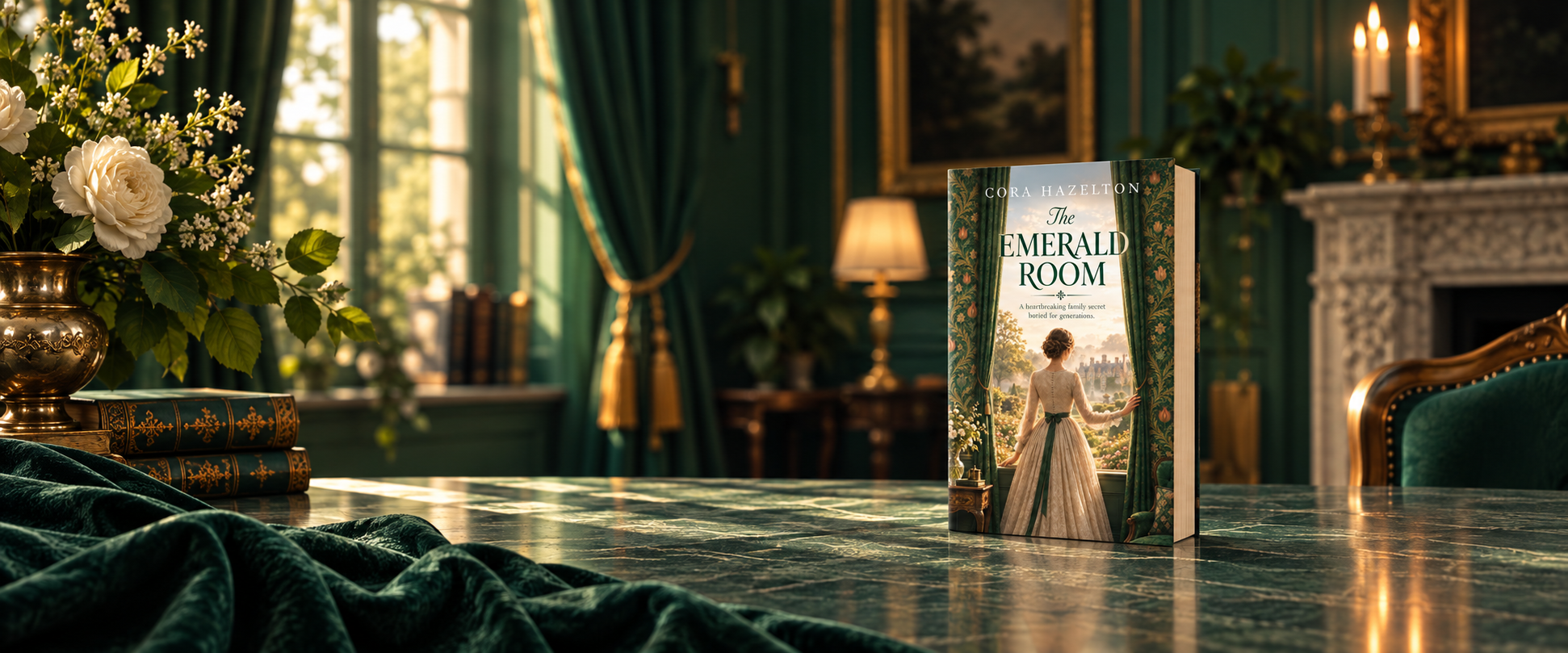
A dual-timeline historical novel

The Emerald Room

A beautiful house.
A forgotten story.
A secret waiting to be uncovered.

The Book

A dark family secret lies behind beautiful wallpaper.

The Emerald Room is a dual-timeline historical novel set between Devon in 1899 and England in 1981, where the traces of one family story reach across almost a century.

Devon, 1899. Elodie dreams of becoming a designer at her family's prestigious wallpaper factory. But as a young woman of privilege, she is expected to marry well and accept the life chosen for her.

When she secretly creates a beautiful new wallpaper design featuring delicate white lilies, it seems she may finally have found a way to make her mark. But her ambitions, and her growing feelings for a young man her family does not approve of, threaten to upset everything her parents have planned for her.

England, 1981. When Anna inherits a beautiful old villa, she believes her luck has finally changed. But among antique furniture, porcelain figurines and forgotten letters, she begins to uncover unsettling clues about the family who lived there before her.

As Anna follows a trail of secrets stretching back almost a century, she begins to question everything she has been told about the past. What really happened to Elodie, and why was the truth buried for so long?

Past & Present

Two women. One family story.

Devon · 1899

Elodie longs to design wallpaper and choose her own future, while her family expects her to follow a very different path.

England · 1981

Anna inherits an old villa and begins to piece together its history through rooms, objects, letters and the people still connected to it.

Behind the Story

The wallpaper that inspired The Emerald Room.

My fascination with historic wallpaper came first. I have always loved the floral patterns, decorative floors and tiny details in old houses. When I began writing Elodie's story, I finally had an excuse to dive much deeper into the history behind the things I already adored.

From pictures to pattern

While researching wallpaper for the book, I was fascinated by the long history behind the patterns on Victorian walls. Pictorial papers could turn a wall into a scene, while design reformers later argued for flatter decoration that worked with the wall rather than pretending to be a window or painting.

Bringing nature indoors

For the book, I wanted to understand why leaves, flowers and other natural forms became such a powerful language for interior design. William Morris's great strength was the way he observed plants closely and then transformed them into rhythmic, repeating patterns.

The women behind the work

While researching Morris & Co. for Elodie's story, I was struck by how little information survives about the women involved. Kate Faulkner, Lucy Faulkner and May Morris are among the few names for whom I found meaningful fragments, and even those records are incomplete.

What I discovered while researching the book

When the wall became part of the design.

I started out simply wanting to understand the rooms I loved looking at. The research quickly became much more interesting. The V&A describes how mid-nineteenth-century wallpaper included everything from realistic floral papers to pictorial and historical scenes, while reformers criticised designs that tried to create an illusion of depth on a flat wall.

For my novel, the important part was what came next. William Morris's patterns did not simply copy a flower or a leaf. He studied nature closely and turned it into a repeating rhythm. His early wallpapers drew on English gardens and hedgerows, and that idea of bringing the natural world into the home is one of the things I find so beautiful about them.

That was exactly the kind of world I wanted Elodie to be looking at when she dreamed of becoming a designer.

Further reading: Wallpaper design reform at the V&A · A brief history of wallpaper at the V&A

The idea I loved Bringing nature into the room without turning the wall into a picture. That tension between image, pattern and nature fascinated me while writing the book.

The women behind Morris & Co.

So little remains.

One of the more frustrating things I found while researching the book was how difficult it was to follow the women behind the firm's work. Kate Faulkner, Lucy Faulkner and May Morris are among the few women for whom I could find fragments of a creative history.

Even then, the record is often incomplete, and it is not always possible to say exactly which woman created which surviving design. So much has simply disappeared. I found that genuinely sad.

That became one of the sparks for Elodie. Her story is fictional, but the question behind it is real: what happens to a talented woman when everyone around her assumes that, even with a family business at her fingertips, her future has already been decided for her?

Historic patterned floor at Evenburg with Cora Hazelton standing on it
Evenburg — I have always loved historic floors almost as much as the wallpaper. I couldn't resist getting a closer look.

Why this became a book

I loved these rooms before I knew Elodie.

There is a very simple truth behind The Emerald Room: I did not fall in love with historic wallpaper because I needed something to research. I wrote the book because I already loved it.

These floral walls, painted doors, patterned floors and decorative ceilings are exactly the kind of details that make me stop on a house tour. Once I started looking at them through Elodie's eyes, the story almost seemed to follow naturally.

Patterns that inspired the book

Golden Lily & Seaweed

These are two of the Morris & Co. designs I kept coming back to while imagining Elodie's creative world. I love the way leaves, stems and flowers are transformed into an almost immersive rhythm.

Golden Lily dates to around 1899; Seaweed was designed later. I use both as visual inspiration for the novel, not as a claim that Elodie necessarily encountered both in 1899.

Watch the craft

How a Morris wallpaper design is printed.

While researching The Emerald Room, I loved discovering how much patient craft sat behind the patterns I was already admiring. The V&A's film recreates the block-printing process used for a William Morris wallpaper design.

The V&A notes that the process can involve many blocks and colours, with each stage printed separately and allowed to dry before the next is added.

Watch the film at the V&A or on YouTube: official video →

A Little More to Read

Step a little further into Elodie's world.

I created a bonus story for readers who would like a little more of the world behind The Emerald Room.

It is available free through my bonus-story page.

Get the Bonus Story
The Emerald Room with its print and digital editions